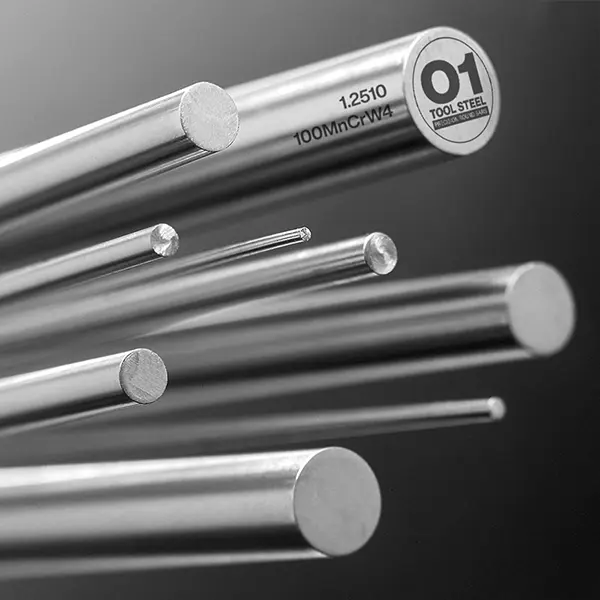
OHNS tool steel (1.2510) is an oil hardening cold work steel designed to provide excellent wear resistance and dimensional stability. Its non shrinking property ensures minimal distortion during heat treatment, making it ideal for producing precision dies, cutters, and gauges. Industrial metal suppliers in the UAE and Gulf region recommend it for applications where accuracy and reliability are critical.
This grade combines high toughness with good machinability, enabling manufacturers to produce long lasting tooling components efficiently. As trusted O1 HNS tool steel suppliers, we provide stock to customers in Oman, Saudi Arabia, and across the Middle East. It performs consistently under repeated use, delivering sharp edges and maintaining shape even in demanding cold work applications.
Applications of OHNS Tool Steel
- Blanking, forming, and trim dies for sheet metal
- Slitting cutters, shear blades, and machine knives
- Thread rolling dies, broaches, and precision tooling
- Plastic mould inserts, gauges, and measurement devices
- Low-volume or general purpose tooling requiring durability and cost efficiency